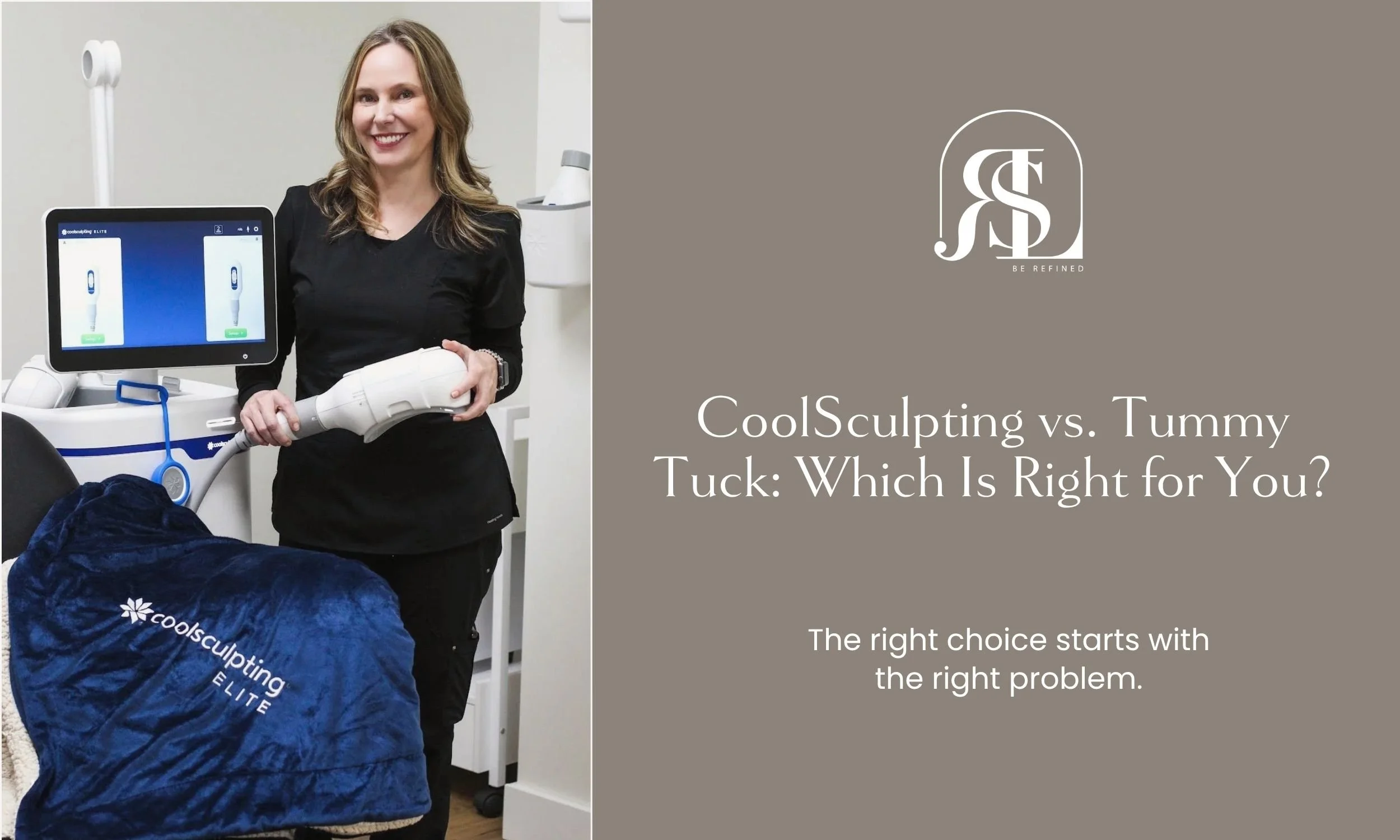
CoolSculpting vs. Tummy Tuck: Which is Right for You?
You're close to your goal weight, but a stubborn pocket of belly fat won't budge no matter how consistent you are with diet and exercise. Somewhere along the way, your research turned into a bigger question: should you do CoolSculpting or a tummy tuck?
CoolSculpting and a tummy tuck can both change how your midsection looks, but they solve different problems. CoolSculpting is a non-invasive treatment that reduces localized fat. A tummy tuck is surgery that removes excess skin and can repair separated abdominal muscles. If a pinchable pocket of fat is your main concern and you want to skip surgery and recovery time, CoolSculpting is likely the more practical starting point.
Choosing based on the name of a procedure instead of the actual issue in your tissue can lead to a disappointing outcome. Stubborn fat, loose skin, and weakened muscles each call for a different approach, and neither treatment is designed for weight loss.
In this article, we'll break down how these two options compare so you can figure out which one fits your body and your goals.
What Is the Difference Between CoolSculpting and a Tummy Tuck?
CoolSculpting and a tummy tuck differ in how invasive they are and what type of tissue they change. CoolSculpting Elite uses controlled cooling, called cryolipolysis, to target and reduce localized fat beneath the skin. A tummy tuck, known medically as abdominoplasty, is a surgical procedure that removes excess skin and can tighten weakened abdominal muscles.
Here's how the two stack up:
| Feature | CoolSculpting Elite | Tummy Tuck |
|---|---|---|
| Procedure type | Non-invasive | Surgery |
| Main goal | Localized fat reduction | Removes loose skin and reshapes the abdomen |
| Incisions | None | Required |
| Anesthesia | Not required | Usually required |
| Muscle repair | Not performed | May be included |
| Loose skin removal | Not performed | Included |
| Scarring | No surgical scar | Permanent abdominal scar |
| Downtime | Little to none | Several weeks |
CoolSculpting doesn't remove skin or touch the abdominal muscles. It targets fat cells and lets your body gradually process them over time. A tummy tuck physically cuts away tissue and can restructure the muscle layer underneath, which is why it produces a more dramatic change.
Which Is Better for Stubborn Belly Fat?
CoolSculpting is generally the better fit when fat is the actual issue. It's cleared to reduce visible fat bulges in areas like the abdomen and flanks, and it's built specifically for fat that can be pinched, remains after diet and exercise, and stays localized rather than spread across the body. A tummy tuck can remove some fat during surgery, but reducing fat isn't its main purpose.
Subcutaneous Fat vs. Visceral Fat
Subcutaneous fat sits below the skin and can be pinched between your fingers. Visceral fat sits deeper, around your internal organs, and isn't visible from the outside. CoolSculpting addresses subcutaneous fat only.
The Lower Belly Pooch
If your lower-belly pooch comes mostly from pinchable subcutaneous fat, CoolSculpting may help. If it comes from loose skin, separated abdominal muscles, or visceral fat, CoolSculpting alone probably won't get you the result you're picturing.
Contour, Not Weight Loss
CoolSculpting reshapes and refines an area. It isn't a weight-loss method, though, and patients who are near their goal weight with a localized concern tend to see the best results.
When Is a Tummy Tuck Better Than CoolSculpting?
A tummy tuck becomes the more appropriate option when the underlying problem is skin or muscle, not fat. That includes significant loose or hanging abdominal skin, skin folds after major weight loss, changes from pregnancy, and diastasis recti, which is a separation of the abdominal muscles. CoolSculpting can't remove excess skin or stitch separated muscles back together.
Loose Skin
Reducing fat can make an area smaller, but it won't surgically remove skin that's already lost its elasticity.
Muscle Separation
Pregnancy and other factors can pull the abdominal muscles apart. A tummy tuck can include surgical repair of that separation. CoolSculpting has no effect on it.
Major Weight-Loss Changes
People with substantial redundant skin after significant weight loss often need surgical removal to reach the contour they're after.
How Do CoolSculpting and Tummy Tuck Results Compare?
CoolSculpting produces a gradual, localized reduction in fat, while a tummy tuck creates a more immediate structural change by removing tissue outright. Results from CoolSculpting typically develop over the following two to three months as your body processes the treated fat cells, and more than one session is often needed. A tummy tuck shows an earlier change in contour, though swelling still takes time to resolve fully.
Subtle Contouring vs. Dramatic Reshaping
CoolSculpting is designed for a smoother, reduced fat bulge, not a surgically flat abdomen. A tummy tuck physically removes tissue, which creates a bigger visual shift than gradually reducing selected fat cells.
Scarring
CoolSculpting requires no incisions and leaves no scar. A tummy tuck leaves a permanent lower-abdominal scar, though surgeons typically place it to stay hidden under clothing.
How Does Recovery Compare Between CoolSculpting and a Tummy Tuck?
Recovery is one of the clearest differences between these two options. CoolSculpting involves no surgery, no anesthesia, and no incisions, so most patients return to their normal routine right away. A tummy tuck is major surgery, and patients typically need meaningful time away from work and exercise while they heal.
CoolSculpting Side Effects
Temporary effects can include:
Redness
Swelling
Tenderness
Bruising
Tingling or numbness
These effects are usually short-lived. We describe this as little to no downtime rather than zero downtime, since some patients notice mild effects for a short stretch afterward.
Tummy Tuck Recovery
Tummy tuck recovery involves restricted movement and lifting early on, several weeks away from heavy exercise, and often a compression garment along with follow-up visits. Exact timelines depend on the surgeon's instructions and the extent of the procedure.
Lifestyle and Scheduling
If you can't take weeks away from work, have caregiving responsibilities, or want to avoid anesthesia and surgical wounds altogether, CoolSculpting fits far more easily into daily life.
How Do the Risks of CoolSculpting and Tummy Tuck Compare?
Because one is non-invasive and the other is surgery, the risk profiles look nothing alike. CoolSculpting carries mild, temporary side effects. A tummy tuck carries the risks that come with any surgical procedure.
CoolSculpting Risks
Beyond the temporary redness, swelling, and numbness mentioned earlier, a rare side effect called paradoxical adipose hyperplasia, or PAH, can cause the treated area to enlarge instead of shrink. Some public discussion and lawsuits have centered on this and other reported adverse effects, so it's a good topic to raise during your consultation.
Tummy Tuck Risks
Surgical risks can include bleeding, infection, fluid buildup, wound-healing complications, changes in sensation, and the risks associated with anesthesia.
Weighing Your Comfort Level
Beyond the result you want, think about how comfortable you are with anesthesia, a permanent scar, and a longer recovery window before deciding which path to take.
Who is a Good Candidate for CoolSculpting Instead of a Tummy Tuck?
You may be a strong CoolSculpting candidate if you're at or near a stable weight, have a pinchable pocket of localized fat, and have reasonably good skin elasticity. Candidates who want to avoid surgery, prefer little to no downtime, and don't need skin removed or muscles repaired tend to see the most satisfying results.
Stable Weight
CoolSculpting shapes a specific area. It doesn't cause broad weight loss.
Pinchable Fat vs. Loose Skin
If the area can be pinched and feels like fat, fat reduction may be relevant. If it feels loose or crepey instead, a different approach probably fits better.
Realistic Expectations
CoolSculpting delivers contour refinement, not the dramatic transformation a tummy tuck can produce.
How Many CoolSculpting Sessions Might You Need?
There's no universal number of CoolSculpting sessions, since most patients need more than one to reach their goals. The right number depends on the amount of localized fat, the treatment area, your anatomy, and how you respond to earlier sessions.
One Session
A single session can produce visible improvement for the right candidate, though whether it reaches your specific goal depends on your starting point.
Multiple Sessions
Staged treatment lets us reassess the area as results develop and adjust the plan as needed.
Where Does the Fat Go After CoolSculpting?
Controlled cooling damages the targeted fat cells, and your body gradually clears them through its normal processes over the following weeks. That's why the change in your midsection shows up gradually instead of overnight.
Future Weight Gain
CoolSculpting removes cells from the treated area, but the remaining fat cells can still enlarge if you gain weight later.
How Long Do CoolSculpting Results Last?
Fat cells removed from the treatment area don't come back in the same way, but that doesn't mean your results are locked in place forever. Remaining fat cells can still enlarge, weight can shift, and skin elasticity changes with age. Maintaining a stable weight helps preserve the contour you achieved with treatment.
Does Skin Sag After CoolSculpting?
CoolSculpting doesn't tighten or remove loose skin, so whether laxity becomes more noticeable afterward depends on your baseline skin elasticity, age, and how much fat was reduced. Someone with a lot of existing loose skin may not be a great fit for CoolSculpting on its own, which is why an assessment before treatment is so important.
Combining Approaches
We often build body-shaping plans around more than one treatment, pairing CoolSculpting Elite with options like CoolTone for muscle tone or Sculptra Body Sculpting when a concern involves more than fat alone.
How Do You Choose Between CoolSculpting and a Tummy Tuck?
Start with the specific problem you're trying to fix, not the name of a procedure. If your priority is a pinchable fat pocket, avoiding surgery, and getting back to your routine quickly, CoolSculpting is the more sensible starting point. If your priority is removing significant loose skin, repairing separated muscles, or correcting major post-pregnancy or post-weight-loss changes, a consultation with a plastic surgeon about a tummy tuck makes more sense.
| Your Main Concern | Where to Start |
|---|---|
| Small lower-belly fat pocket | CoolSculpting |
| Localized fat with good skin elasticity | CoolSculpting |
| Want to avoid surgery and downtime | CoolSculpting |
| Significant hanging abdominal skin | Tummy tuck consultation |
| Separated abdominal muscles | Tummy tuck consultation |
| Major post-weight-loss skin excess | Tummy tuck consultation |
Patients who start out researching tummy tuck surgery often find during a consultation that their main concern is a localized fat pocket rather than excess skin or muscle separation. For those patients, surgery is more procedure and recovery than the goal calls for. Starting with the least invasive option that fits the concern is usually the smartest first move.
Try CoolSculpting Elite in Chanhassen, MN
CoolSculpting treats localized fat. A tummy tuck surgically removes skin and can repair muscle separation. Surgery isn't automatically the answer for every lower-abdominal concern, especially if your issue is a pinchable pocket of fat and your skin still has good elasticity.
Refine Laser & Skin Care offers CoolSculpting Elite as part of a personalized body-shaping approach in Chanhassen, along with CoolTone and other options for patients whose concerns go beyond fat alone.
Schedule a consultation with our team to pinpoint the source of your abdominal concern. It could be fat, muscle tone, skin laxity, or a mix of the three, and we'll build a plan around what your body needs.